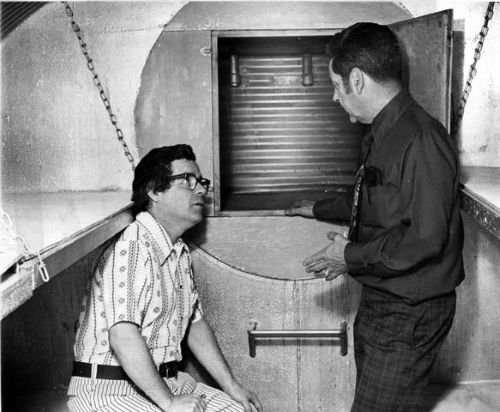
The forgotten story of the EMO, Roy Margetts, and the city’s nuclear fallout shelter
“Most people in Guelph never knew it existed. But deep inside the city’s infrastructure, a small room waited for a day everyone hoped would never come.”
During the height of the Cold War, when nuclear anxiety shaped everything from school drills to government budgets, Guelph quietly built something extraordinary — a fully equipped Emergency Municipal Government Shelter, a nuclear-era command centre designed to keep the city functioning after an attack.
At the heart of that hidden world was one man: Roy Margetts, the EMO Co‑ordinator for Guelph and Wellington County.
This is the story of the bunker, the organization behind it, and the people who kept watch while the rest of the city slept.
1. The Cold War Comes to Guelph
In the late 1950s and early 1960s, the threat of nuclear war felt real. Canada, as a NATO member and close U.S. ally, was considered a potential target. The federal government responded by creating the Emergency Measures Organization (EMO) in 1959 — a national civil‑defence network tasked with preparing Canadians for nuclear attack, fallout, and post‑disaster survival.
Across the country, cities and counties were instructed to:
- Build emergency plans
- Train radiological monitoring teams
- Establish communication networks
- Prepare shelters for government continuity
Guelph took this seriously.
2. The Birth of the Guelph–Wellington EMO
By 1957, Guelph and Wellington County had formed a joint EMO unit — one of many across Ontario. Their mandate was broad:
- Coordinate emergency planning
- Train volunteers
- Maintain radiological equipment
- Prepare for everything from floods to nuclear war
But as the Cold War intensified, the focus shifted heavily toward nuclear preparedness.
This led to the creation of one of Guelph’s most unusual Cold War artifacts:
the Emergency Municipal Government Shelter.
3. The Fallout Shelter: Guelph’s Hidden Command Centre
This wasn’t a public shelter for thousands of residents.
It was a government continuity bunker — a place where a small group of officials could operate the city if the world above was in chaos.
What we know from the archival record
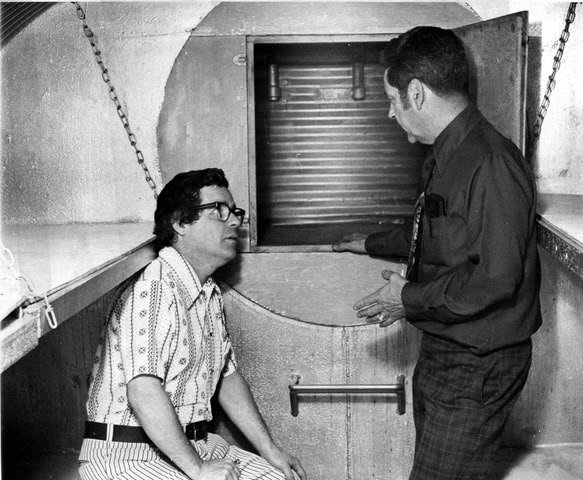
Two surviving photographs from the Guelph Public Library Archives confirm its existence:
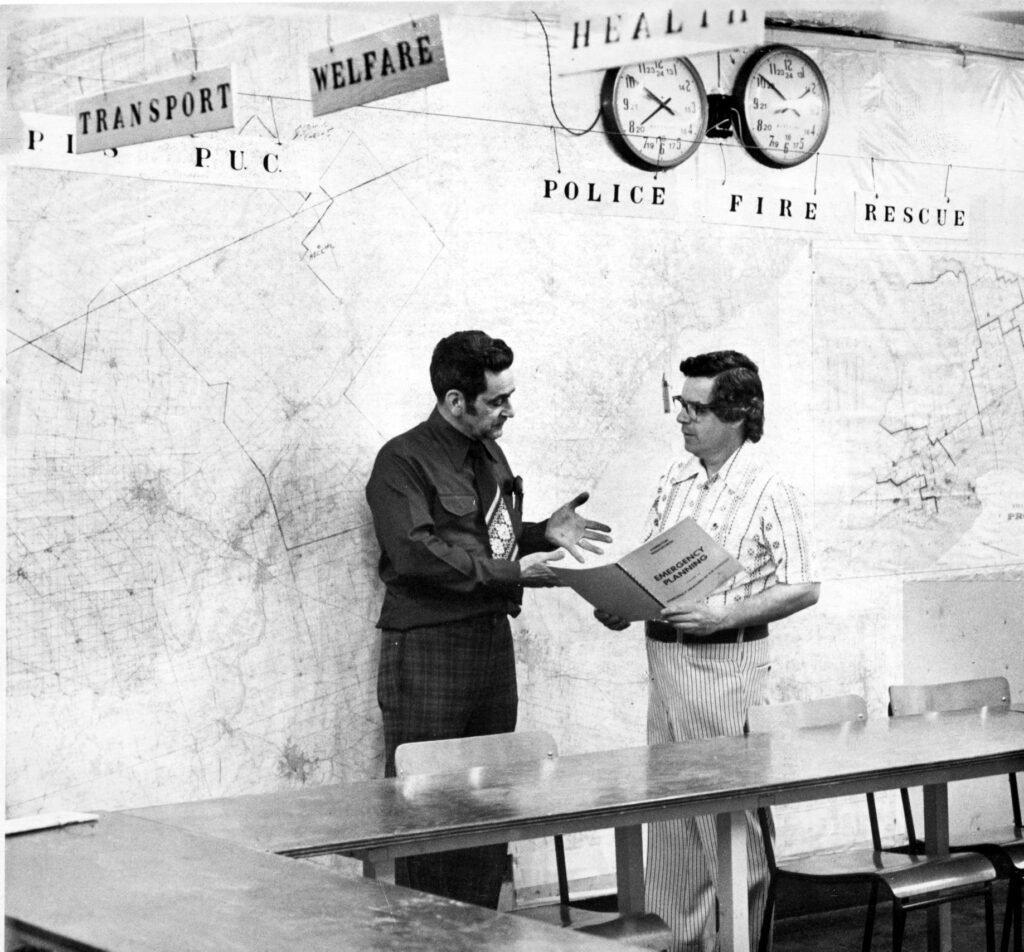
“Roy Margetts (left) and Alderman Mel Cochrane inside the control room of the Emergency Municipal Government Shelter, May 30, 1975.”
Source: Guelph Public Library Archives
The photo shows a compact but fully equipped control room — maps, communication equipment, status boards, and radiological instruments. This was the nerve centre where Guelph’s emergency government would have operated during a nuclear crisis.
The shelter would have included:
- Reinforced walls
- Independent power
- Communication lines
- Fallout monitoring equipment
- Emergency supplies
- Maps and planning boards
It was part of a nationwide network of municipal bunkers built quietly during the Cold War.
4. Roy Margetts: The Man Behind the Plan
By the 1970s, the EMO Co‑ordinator for Guelph and Wellington County was Roy Margetts — a man whose job was to think about disaster so others didn’t have to.
His responsibilities included:
- Maintaining the fallout shelter
- Training radiological monitoring teams
- Running emergency simulations
- Coordinating with provincial and federal EMO offices
- Managing equipment and communication systems
He was the quiet backbone of Guelph’s Cold War readiness.
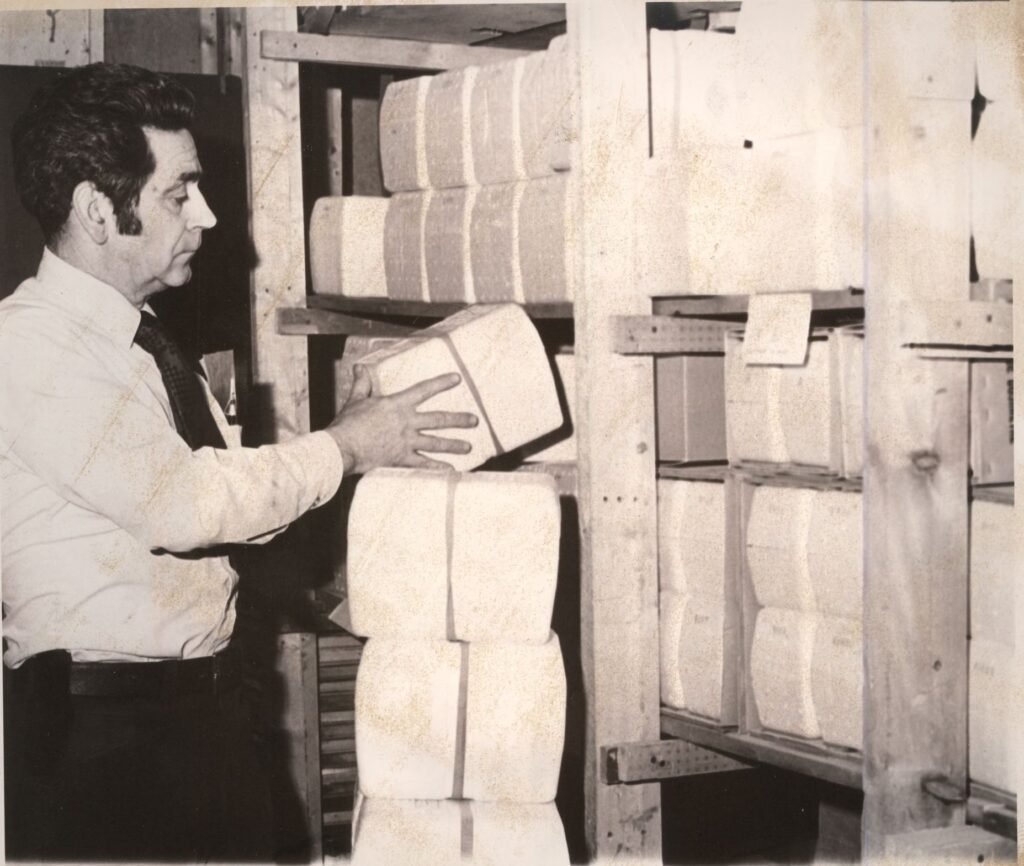
“Roy Margetts packing radiological survey equipment on the final day of the EMO, December 31, 1975.”
Source: Guelph Public Library Archives
This second photo is symbolic — the end of an era.
The equipment he’s packing up was used to measure radiation levels after a nuclear blast. Sending it back to the province marked the shutdown of Guelph’s EMO program.
5. Inside the Bunker: What It Was Like
While detailed blueprints aren’t publicly available, we can infer its layout from similar municipal bunkers across Ontario:
Typical features included:
- A control room with maps, phones, radios, and status boards
- A communications room linked to provincial networks
- A radiological monitoring station
- Emergency rations and water
- Ventilation systems with fallout filtration
- Thick concrete walls for blast and radiation protection
These bunkers weren’t luxurious.
They were functional, cramped, and built for survival — not comfort.
6. The End of the EMO Era
By the mid‑1970s, several factors led to the dismantling of local EMO units:
- Public belief that nuclear war was “unsurvivable”
- Budget cuts
- Shifting political priorities
- Declining volunteer participation
On December 31, 1975, the Guelph EMO officially shut down.
The bunker remained, but its purpose faded into history.
Roy Margetts’ final archival photo — returning the radiological equipment — captures the quiet end of Guelph’s Cold War civil‑defence chapter.
7. What Remains Today
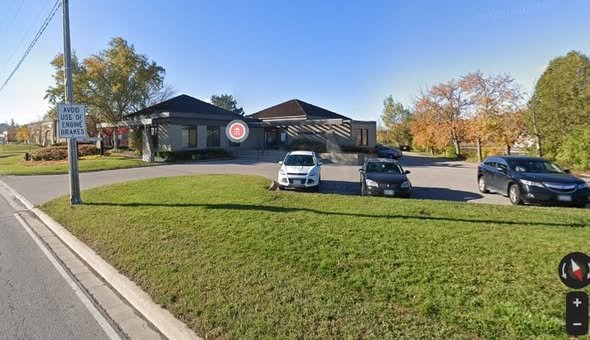
The physical shelter may still exist within Guelph’s municipal infrastructure, though its current condition and accessibility are unknown.
What does remain is:
- The archival photographs
- The documented existence of the bunker
- The memory of the EMO staff
- The story of a city preparing for the unthinkable
Most residents never knew this hidden world existed beneath their feet.
8. Why This Story Matters
This chapter of Guelph’s history reveals:
- How global tensions shaped local planning
- How ordinary people like Roy Margetts carried extraordinary responsibilities
- How the city prepared for a future that, thankfully, never arrived
- How much of Guelph’s history lies hidden beneath the surface
For Historic Guelph, this story is a perfect example of the city’s forgotten layers — the things built in silence, maintained in secrecy, and remembered only through a few surviving photographs.