



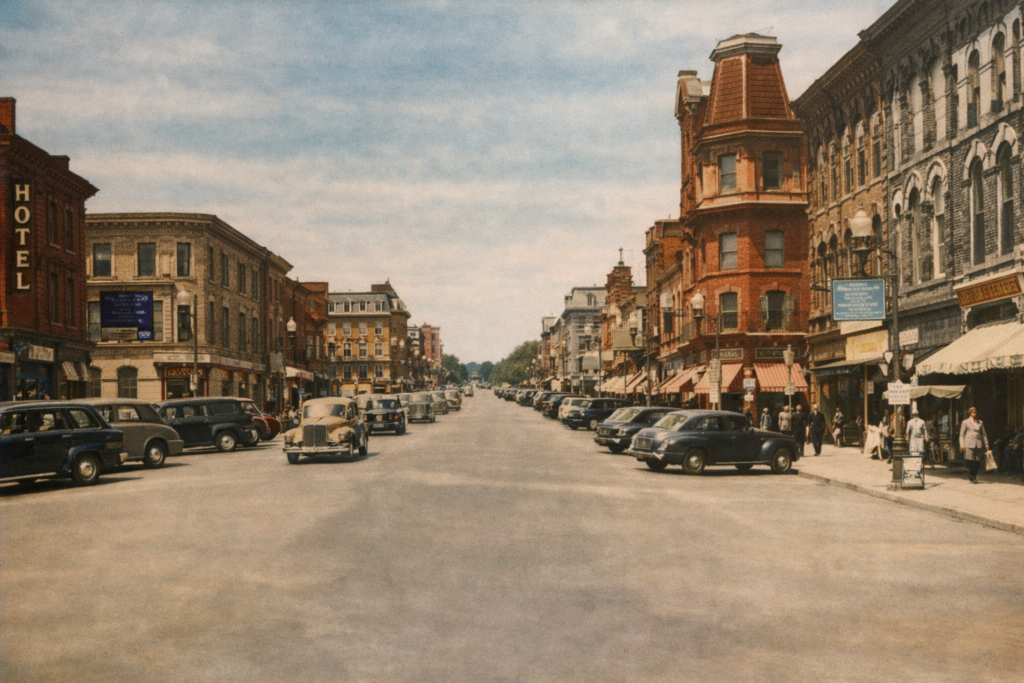
From ancient homelands to a planned “Royal City”
Long before streets were surveyed or stone buildings rose along the Speed River, the land we now call Guelph was part of a much older story.
Archaeological evidence shows that Indigenous peoples used this area as early as 11,000–10,300 years ago, following the retreat of the last ice age. Later, the region formed part of the territory of the Chonnonton (Neutral) peoples, who occupied large parts of southern Ontario until the mid‑1600s, when war, disease, and displacement—especially conflict with the Haudenosaunee—shattered their communities. The Canadian Encyclopedia
After 1690, the Mississaugas, an Anishinaabe people, moved into the region, settling along the major rivers and waterways that fed into Lakes Ontario and Erie. In 1784, as Loyalist and settler pressure increased after the American Revolution, the British Crown negotiated a massive land purchase from the Mississaugas, which included the future site of Guelph. Guelph Museums The Canadian Encyclopedia
This land—rich in forests, rivers, and fertile soil—would soon be drawn into a new experiment in colonization.
The Canada Company and a bold colonial experiment
In the 1820s, Britain was looking for ways to turn “Crown reserves” and other lands in Upper Canada into revenue and settlement. The answer, in part, was a private land development venture: the Canada Company, chartered in 1825 and formally incorporated in 1826. Wikipedia
The Canada Company purchased roughly 2.5 million acres of land in what became known as the Huron Tract, stretching toward Lake Huron. The Crown had previously acquired much of this territory from the Mississaugas through treaties such as the Between the Lakes Purchase (No. 3, 1792). Guelph Museums Wikipedia
To make this vast holding profitable, the company needed more than scattered farms—it needed planned towns that could serve as administrative, commercial, and transportation hubs. For that, they turned to a Scottish novelist and promoter with a flair for vision and drama: John Galt.
John Galt and the founding of Guelph (1827)
John Galt, already known in literary circles and deeply involved in colonial promotion, became the first superintendent of the Canada Company. He arrived in Upper Canada in 1826 with a mandate: open up the Huron Tract, attract settlers, and make the land pay. Guelph Museums Wikipedia
Galt believed in the idea of a “planned town”—a community laid out in advance of settlement, with streets, public spaces, and key facilities designed to impress and attract newcomers. For the company’s headquarters, he chose a site on the Speed River, a strategic location in south‑central Upper Canada.
On April 23, 1827, Galt formally founded the town of Guelph. He named it in honour of Britain’s royal family, the Hanoverians, whose ancestral line included the Guelf (Guelph) dynasty—hence the later nickname, “The Royal City.” Guelph Museums The Historical Marker Database
Galt’s town plan was distinctive: streets radiated outward from a central focal point, an imaginative layout influenced by other planned towns such as Buffalo, New York. That radiating pattern is still visible in downtown Guelph today. Guelph Museums The Canadian Encyclopedia
A frontier town with theatrical beginnings
The story of Guelph’s founding has been retold many times, not least by Galt himself in his 1833 autobiography. He described the journey through dense forest, getting lost with his companion Dr. William “Tiger” Dunlop, and finally arriving at the chosen site in the rain, near a rough shelter built by an Indigenous man who had sought refuge there. guelphheritage.ca
On the day of the founding, Galt is said to have marked the occasion by felling a tree—often described as a maple—as a symbolic act of beginning the town. Whether embellished or not, the story captures the mix of theatre, ambition, and uncertainty that surrounded this new settlement in the bush.
Guelph was intended to be more than just another village. It was the administrative and promotional showpiece of the Canada Company, a place meant to impress investors, attract settlers, and anchor the development of the surrounding countryside.
Early growth, setbacks, and recovery
In its first years, Guelph grew as a service centre for the surrounding farms and as the headquarters of the Canada Company’s operations in the region. Mills, inns, shops, and workshops appeared along the rough streets, and the town began to take shape.
But Galt’s relationship with the company’s directors in London deteriorated. Disputes over finances, management, and expectations led to his recall to Britain in 1829. Without its charismatic founder and promoter, Guelph’s early momentum slowed, and the town’s fortunes dipped. Guelph Museums The Historical Marker Database
The story didn’t end there. As agricultural settlement expanded in the surrounding region, Guelph’s position at the centre of a productive farming district gave it new life. Its designation as the administrative centre for the Wellington District in the mid‑1800s further strengthened its role as a regional hub. The Canadian Encyclopedia The Historical Marker Database
From village to town to city
Guelph’s formal civic status evolved alongside its growth:
- 1851 – Incorporated as a village
- 1856 – Elevated to a town
- 1879 – Incorporated as a city, on April 23—the same date as its founding, 52 years earlier. Guelph Museums The Canadian Encyclopedia The Historical Marker Database
By the late 1850s, Guelph had also become a railway centre, with lines connecting it to other key communities in Ontario. Rail access encouraged the development of light industry, which diversified the local economy beyond agriculture and services. Factories, workshops, and warehouses joined churches, schools, and civic buildings in shaping the city’s skyline. The Canadian Encyclopedia The Historical Marker Database
Indigenous land, colonial town
Any honest history of Guelph has to hold two truths together:
- The city is a remarkable example of a planned colonial town that grew into a thriving industrial and educational centre.
- It stands on land that was part of the ancestral homelands of Indigenous peoples, including the Chonnonton and later the Mississaugas, whose displacement and dispossession made colonial settlement possible. Guelph Museums The Canadian Encyclopedia
The Canada Company’s success in populating the Huron Tract has been called “the most important single attempt at settlement in Canadian history”—but it also meant that Indigenous communities were pushed aside, their lands transformed into surveyed lots, farms, and towns. Wikipedia
Today, remembering Guelph’s beginnings means acknowledging both the ambition of its founders and the deep, older histories of the land and peoples who were here long before 1827.
The modern Royal City
From its origins as a planned headquarters in the forest, Guelph has grown into a city known for:
- Historic limestone and brick architecture
- A strong industrial and manufacturing base
- Its role as an educational centre, including the University of Guelph
- A vibrant arts, culture, and heritage community
Set in the heart of a rich agricultural region, Guelph today is home to more than 140,000 residents, but its downtown street pattern and many of its buildings still echo John Galt’s original vision. The Canadian Encyclopedia
Why this history matters
For those who grew up here—or who still walk these streets—Guelph’s history isn’t just a list of dates and names. It’s:
- The curve of a familiar street that once radiated from Galt’s central plan
- The stone walls and church spires that watched generations come and go
- The factories, rail lines, and shops that built livelihoods
- The deeper, often unspoken stories of the land and the peoples who first cared for it
Historic Guelph exists to hold all of these layers together—from the ancient footprints along the Speed River to the day John Galt swung his axe, to the city that stands here now.
This is how it all started.
And every memory, photograph, and story we preserve adds another line to Guelph’s ongoing chapter.