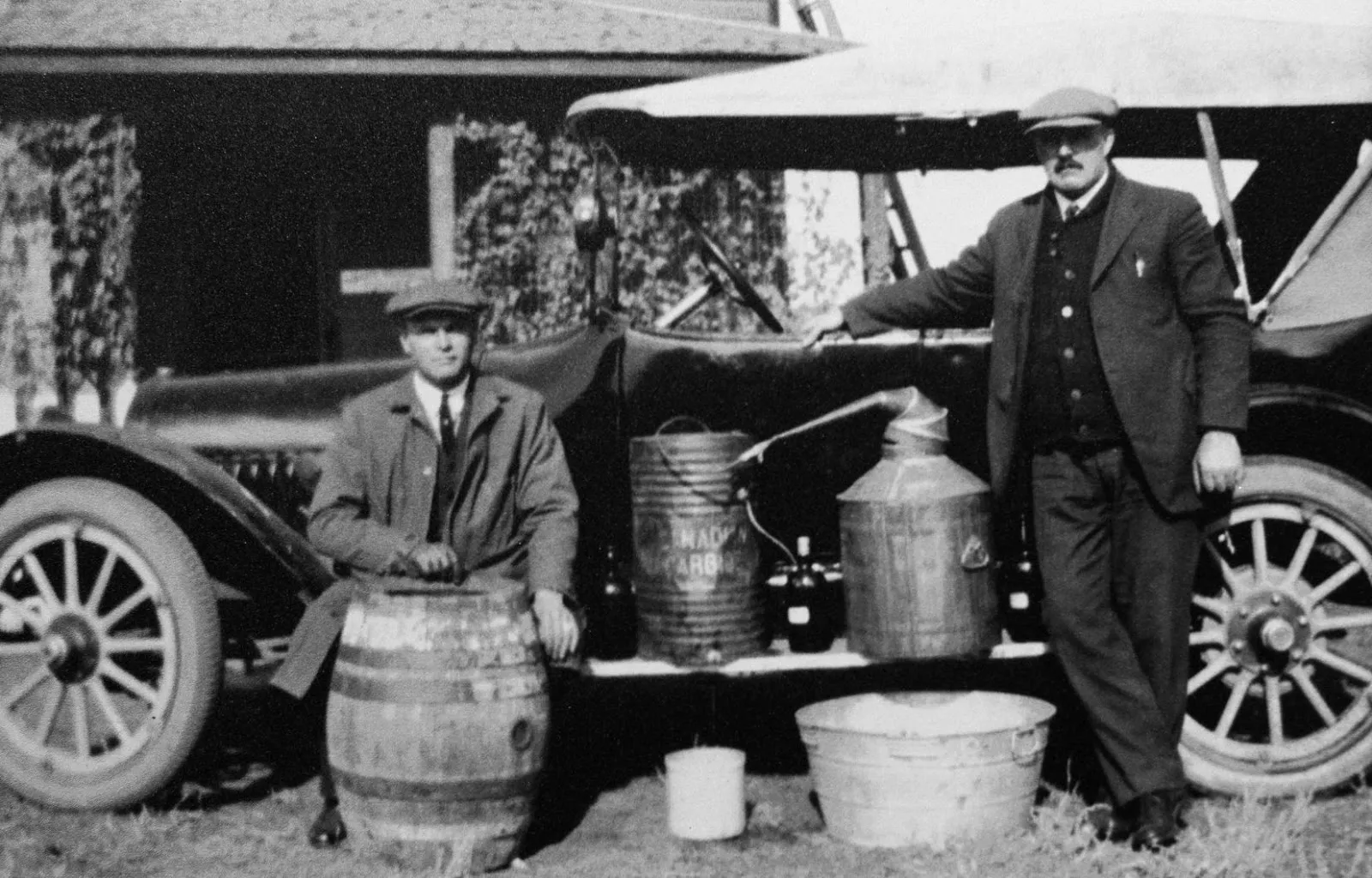
A Historic Guelph Feature Article
How Canadian Booze Flooded the United States During Prohibition
From 1920 to 1933, the United States went dry — at least on paper. In reality, Americans drank more than ever, and much of what they drank came from Canada, funneled across lakes, rivers, and backroads by a vast underground network of smugglers, bootleggers, and organized crime syndicates.
Ontario — and especially the corridor from Windsor to Niagara — became the beating heart of the North American liquor pipeline. And while Guelph was not a border town, its breweries, including the Sleemans, played a role in the supply chain that fed the American thirst.
This is the full story of how Canadian alcohol — beer, whisky, gin, and everything in between — became the lifeblood of American speakeasies, gangsters, and jazz‑age nightlife.
1. The Stage Is Set: Two Countries, Two Laws (1916–1920)
Before the U.S. banned alcohol, Ontario had already enacted the Ontario Temperance Act (1916), which prohibited domestic sale but still allowed breweries and distilleries to produce alcohol for export.
When the U.S. passed the Volstead Act (1920), banning alcohol nationwide, a perfect storm formed:
- Canada could legally produce alcohol
- The U.S. could not legally buy it
- But Americans desperately wanted it
This created one of the largest black‑market industries in North American history.
2. The Smuggling Routes: Lakes, Rivers, and the “Frost‑Proof Highway”
Smugglers used every possible route to move Canadian alcohol south:
Lake Erie & Lake Ontario
Fast “mosquito boats” — long, narrow, high‑powered craft — ran at night without lights, hugging the waves to avoid detection. Winter made it even easier: frozen lakes became ice highways, allowing cars to drive straight across.
The Detroit River
The busiest smuggling corridor in the world. At its narrowest point, it’s less than a kilometre wide — perfect for:
- Rowboats
- Canoes
- Submerged tow‑lines
- Underwater cables
- Floating crates marked with discreet buoys
Niagara & St. Catharines
This region became the headquarters of Rocco Perri, Canada’s most notorious bootlegger, often called “Canada’s Al Capone.”
Quebec & the Maritimes
Whisky and rum flowed into New England through fishing boats, cargo ships, and even disguised church vessels.
3. The Canadian Suppliers: Breweries, Distilleries, and “Export Only” Loopholes
Canadian breweries and distilleries were not required to verify where their “export” shipments actually ended up. As long as paperwork claimed the alcohol was destined for:
- The Caribbean
- South America
- “Medicinal” distributors
- “Industrial” buyers
…no one asked questions.
This loophole was exploited by:
- Hiram Walker
- Gooderham & Worts
- Corby
- Seagram
- And yes — Sleeman
Most breweries did not smuggle directly. Instead, they sold to intermediaries who handled the illegal transport. This allowed companies to maintain plausible deniability while still profiting from the booming demand.
4. The Sleeman Connection: Fact, Fiction, and the Capone Question
The Sleeman family’s involvement in Prohibition‑era smuggling is one of the most debated pieces of Guelph history.
What is historically confirmed:
- Sleeman beer was sold to exporters who supplied U.S. bootleggers.
- The 1926 Royal Commission on Customs and Excise documented Sleeman involvement in unreported exports and tax irregularities.
- This contributed to the 50‑year ban placed on the family in 1933.
What is not confirmed:
- That Al Capone personally visited Guelph
- That he stayed at the Albion Hotel
- That he had direct dealings with the Sleemans
So where does Capone fit in?
Capone’s Chicago empire consumed enormous quantities of Canadian alcohol — especially whisky — but his supply lines ran primarily through:
- Windsor–Detroit
- Hamilton
- St. Catharines
- The Niagara corridor
The man most directly connected to Ontario smuggling was Rocco Perri, who controlled much of the cross‑border trade. Perri’s network absolutely handled beer from Ontario breweries, including Sleeman, but there is no archival evidence that Capone personally dealt with the Sleemans.
Why the Capone myth persists
Because it feels true.
Because it’s dramatic.
Because it sells beer.
And because the Sleeman revival in the 1980s leaned into the legend as part of its marketing identity.
But the real story — a respected Guelph brewing dynasty caught in the gears of a continent‑wide smuggling machine — is compelling enough on its own.
5. The Bootleggers: Rocco Perri, The Purple Gang, and the American Syndicates
Rocco Perri (“King of the Bootleggers”)
Based in Hamilton and St. Catharines, Perri ran the largest smuggling network in Ontario. He coordinated shipments from breweries and distilleries, arranged transport, and negotiated with American buyers.
The Purple Gang (Detroit)
A violent Jewish‑American crime syndicate that controlled Detroit’s side of the river. They handled much of the Canadian liquor entering Michigan.
Al Capone (Chicago)
Capone’s organization purchased massive quantities of Canadian alcohol — especially whisky — but he rarely dealt directly with Canadian suppliers. Instead, he bought from intermediaries like the Purple Gang.
Local “River Rats” and Small‑Time Runners
Not all smugglers were gangsters. Many were:
- Fishermen
- Farmers
- Factory workers
- Out‑of‑work veterans
- Teenagers with fast boats
Smuggling was dangerous, but the money was irresistible.
6. The End of Prohibition and the Aftermath (1933)
When the U.S. repealed Prohibition in December 1933, the smuggling industry collapsed overnight.
But in Canada, the consequences lingered.
For the Sleemans:
The Canadian government charged the family with:
- Smuggling
- Tax evasion
- Falsifying export documents
The penalty was unprecedented:
A 50‑year ban on brewing.
The Sleeman name disappeared from the industry until its revival in 1988.
7. Legacy: How Prohibition Shaped Canadian Identity
Prohibition left a deep mark on Canadian culture:
- It cemented Canada’s reputation as the “wet” neighbour to America’s “dry” experiment.
- It created folk heroes, villains, and legends.
- It shaped the mythology of breweries like Sleeman, Seagram, and Hiram Walker.
- It turned border towns into economic powerhouses.
- It left behind stories that still fascinate historians, filmmakers, and beer lovers today.
And it remains one of the most colourful, dramatic, and uniquely Canadian chapters in Guelph’s brewing heritage.